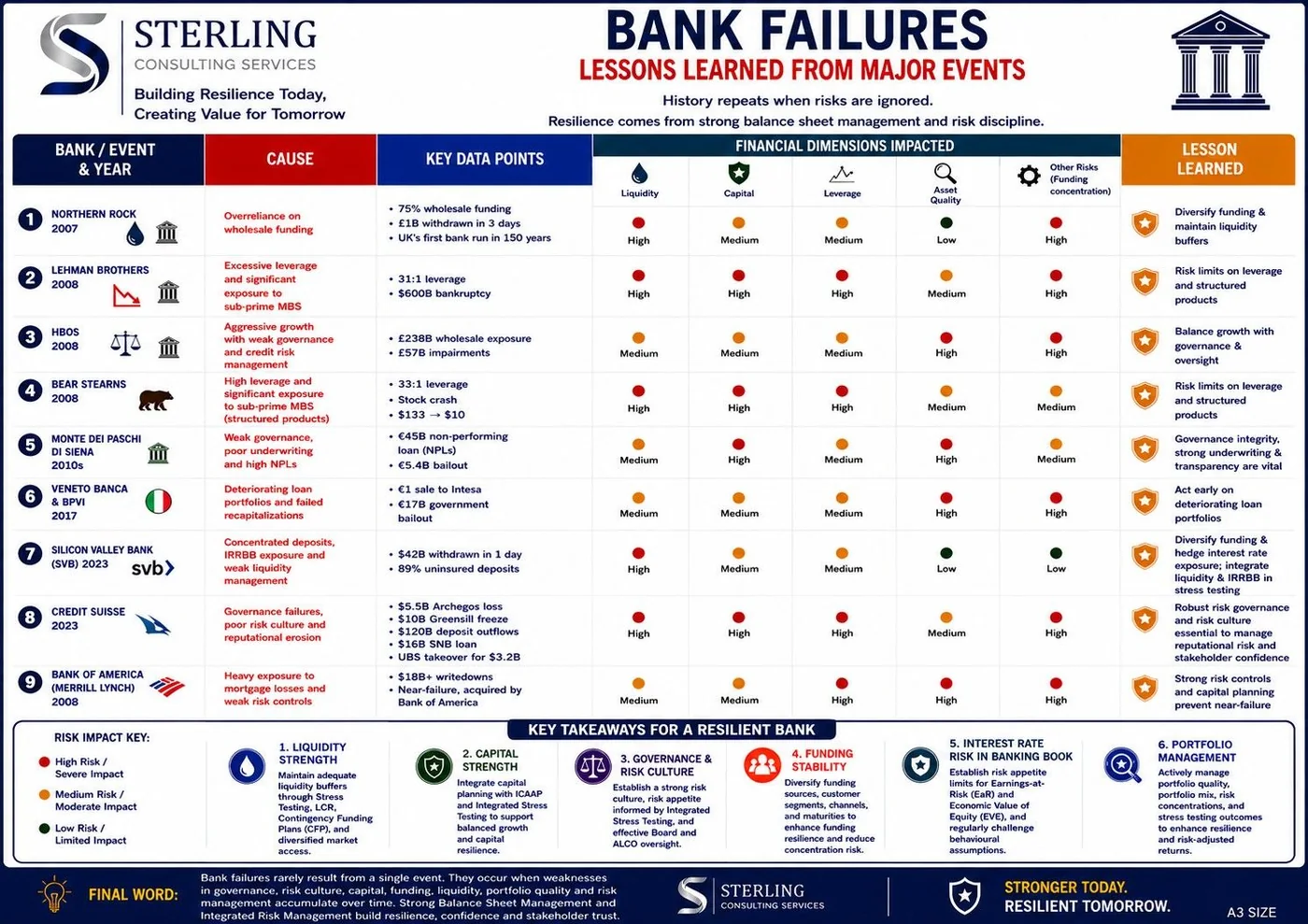
The collapse of major financial institutions over the past two decades — from Northern Rock and Lehman Brothers during the Global Financial Crisis to Silicon Valley Bank and Credit Suisse in 2023 — demonstrates a timeless truth:
These vulnerabilities can take many forms:
As financial markets become increasingly interconnected and technology accelerates the speed of information and fund movements, the importance of robust Balance Sheet Management (BSM) has never been greater.
The banking landscape has fundamentally changed. Historically, bank runs unfolded over weeks. Today, digital banking, social media and instant payments mean liquidity crises can develop in hours. The rapid deposit outflows at Silicon Valley Bank demonstrated how quickly confidence can evaporate.
For financial institutions, resilience requires an integrated approach across six critical areas:
Liquidity stress is often the symptom; weak Balance Sheet Management is, more often than not, the root cause. Institutions that successfully integrate Balance Sheet Management, Portfolio Optimisation and rating-metrics management are better prepared — they withstand stress and emerge stronger.
In today's volatile and interconnected world, effective Balance Sheet Management is essential for enhancing financial resilience, maintaining stakeholder trust and creating long-term sustainable value.
Join the discussion on LinkedIn
Part of The Balance Sheet Doctor — Sterling Consulting's Building Financial Resilience series.
This insight examines how weak governance and risk culture allow capital, funding, liquidity and IRRBB vulnerabilities to accumulate into failure.
Explore the full interdependency map →If you want an independent view of how your balance sheet, risk culture and framework would hold up under stress, a structured diagnostic can surface the gaps before they matter.
Request a Diagnostic Review