Shareholders, boards, and the limits of both — what the Tata Trusts vs Tata Sons dispute reveals about constitutional governance.
By Sridhar Aiyangar, Founder & Managing Director · October 2026
The fight at the top of the Tata Group is being reported as a clash of personalities. The more useful question is structural: can a board take a decision its ~66% shareholder opposes?
Neither position stands neatly — "shareholders own it, so they decide" or "directors are independent, so shareholders cannot interfere" — and the answer is far more nuanced.
Both contain truth. Each fails on its own.
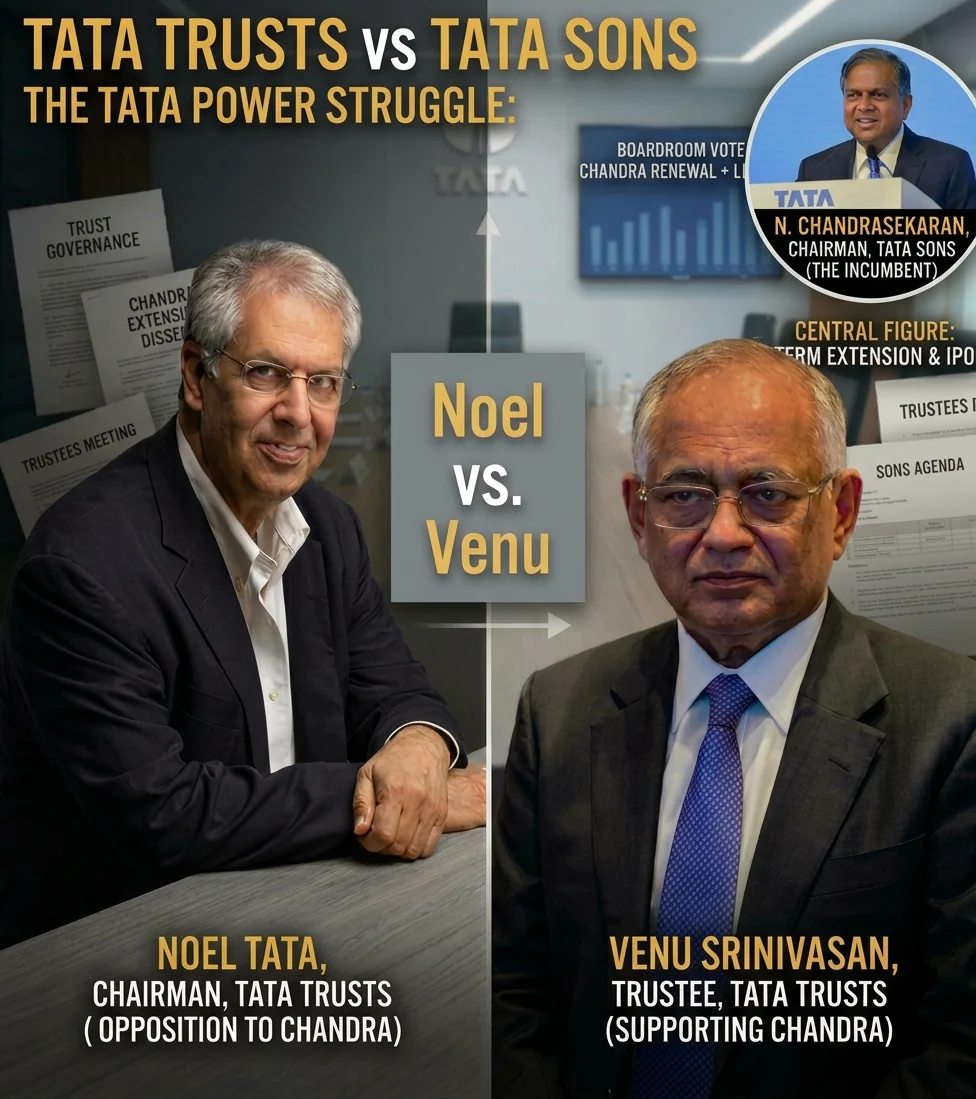
The dispute at Tata Sons is being reported as a clash between Noel Tata and Venu Srinivasan, with Chairman N. Chandrasekaran in the middle. To some extent that is true but positioned that way, it is a story about personality clash. When analysed properly, it is a question every board with a dominant shareholder may potentially face.
The questions that come up precisely: Can the Tata Sons Board take a decision when Tata Trusts have a split vote considering the casting vote protection provisions, when the Trusts own about 66% of the company? Shareholders do not manage the company, so ownership alone does not decide. Directors are not sovereign either, because their authority is granted by the statute and by the company's own constitution — and that constitution can give dominant shareholders specific rights.
The dispute now carries a second layer. Each camp accuses the other side's key figures of conflicts of interest. Those allegations do not settle the legal question. They do shape how a court or a regulator may view the people casting the votes.
The resolution is not that one side wins in principle. It is that both operate inside a constitution. Shareholders set the rights, through the statute and through the Articles they adopt. Within that frame, the board decides, and each director owes judgment to the company rather than to whoever nominated him. Where that frame is drafted loosely, the dispute is not about governance philosophy at all. It is about two questions.
Statute → Articles of Association → Nomination Rights → Affirmative-Vote Test → Casting Vote → Board Decision → General Meeting
Shareholders own shares; the board manages the company. Section 179 of the Companies Act, 2013 vests the company's powers in the board, except those the Act or the Articles reserve for shareholders in general meeting. Ownership and management are separated by design, not by accident.
So, a shareholder holding 66%, or 99%, cannot ordinarily tell a director how to vote. Under Section 166 a director's duties run to the company, and a nominee director cannot subordinate them to his nominator. Without that rule, a board of nominees would be nothing more than a shareholder voting committee wearing fiduciary language.
On this point Venu Srinivasan stands on firm ground. If he believes a proposal serves Tata Sons, being a Trusts nominee does not oblige him to vote as Noel Tata wishes.
The board's authority comes from the statute and the company's constitution. A director cannot invoke independence to set aside a voting rule written into the Articles. The useful distinction is between influence and instruction. Designing the governance architecture — reserved matters, nomination rights, affirmative-vote thresholds — is legitimate shareholder influence. Directing an individual vote inside that architecture is instruction, and instruction is what independence forbids.
That distinction cuts both ways here, and it is worth holding on to, because each side invokes the half that suits it.
The Trusts' power does not rest on the ordinary weight of a 66% holding. It is written into Tata Sons' Articles of Association. Article 104B lets the Sir Dorabji Tata Trust and the Sir Ratan Tata Trust, while their combined holding stays above a set threshold, nominate one-third of the board.
The whole dispute turns on how those two sentences of Article 121 fit together. And the public debate rarely quotes the second one.
Tata Sons' adviser Sudipto Sarkar reads the casting vote as available in two situations:
On that reading, the plain words favour Tata Sons.
However, if the casting vote attaches only to the overall Board count, they favour the Trusts as there is no clear affirmative vote from the nominee directors of Tata Trusts: 1–1 tie.
Anyone judging the merits needs the exact wording first.
The Board passed Chandrasekaran's reappointment 4–1 — but only after a casting vote broke a tie between the two Trust nominees.
The board has six members; Chandrasekaran did not vote on his own position. Srinivasan voted for, Noel Tata against, and the meeting's chair, independent director Harish Manwani, used his casting vote in favour.
The same meeting approved a plan to list Tata Sons, again with Noel Tata the sole dissenter.
The only live question is therefore the separate Article 121 test among the nominees — and whether an independent director's casting vote can settle it.
The Trusts' strongest argument is about purpose, not arithmetic. Article 121 exists to protect the Trusts. If an independent director's casting vote can override a split among the Trusts' own nominees, the protection can be defeated by the very people it was meant to check.
Tata Sons has a fair answer. The right was given to the nominee directors, not to the trustees. When the nominees themselves disagree, the Trusts' voice is genuinely divided; and a tie-break may be exactly what the drafters intended.
Noel Tata has also raised a procedural point: contending that the 2022 reappointment ran under Article 118 while the 2026 process ran under Article 121, while Tata Sons disagree and state that Article 118 is only for the first-time appointment. The records will settle which process was followed in 2022.
The sharpest new allegation is that the director whose vote decided the nominee split has an undisclosed business link to the family of the man he voted to reappoint.
A note on what follows: none of the material below is a finding. Each item is a reported allegation, with the response given where one has been reported, in some instances none has been. Both camps have made accusations. They are set out here because they bear on the governance question, not because they have been established.
The conflict accusations are not one-directional.
The Trusts can argue that a trustee used a regulatory complaint against his own trust while his removal as its nominee was being considered. Srinivasan can answer that he raised a genuine statutory breach, one an independent complainant had raised ten days earlier. Either way, the freeze that followed is what left SDTT acting alone in September — a procedural accident with substantive consequences.
After the 17th September meeting, Srinivasan wrote to the Commissioner seeking an immediate inquiry into the Sir Dorabji Tata Trust: the appointment and status of SDTT's perpetual trustee; the basis on which Noel Tata became and remains chairman of Tata Trusts; Neville Tata's appointment and Srinivasan's own exclusion from that decision; and SDTT's involvement in Tata Sons' commercial and strategic affairs.
He alleges that the Trusts' chairman and staff have themselves identified and negotiated major Tata Sons transactions — a conduct he says falls outside the Trusts' charitable objects and exposes the corpus to large tax consequences. He calls Resolution No. 107 "a power grab within SDTT" meant to dictate Tata Sons' decisions. Tata Trusts have filed caveats asking to be heard before any order is passed.
The Trusts' side has replies. A former senior Tata official notes Srinivasan was party to the Trusts' decisions over the past two years. An insider attributes his grievance partly to tenure: Noel Tata is a perpetual trustee, while Srinivasan holds a three-year term. Read uncharitably, both complaints target trustees who stood between him and his preferred outcome. Read charitably, he is raising statutory questions the regulator was already examining.
The Hanno lease is not a contract with Tata Sons, so the disclose-and-abstain rule in Section 184 does not obviously apply. The better hook is Section 166(4), which bars a director from situations where he has a direct or indirect interest that conflicts, or may conflict, with the company's. Whether a counterparty relationship between the director's group and the candidate's family meets that test is arguable either way.
The bigger effect is on the independence argument itself. Srinivasan's defence of his vote rests on independent judgment exercised for Tata Sons. That defence is only as strong as the judgment is unconflicted. If a court treated his vote as compromised, the nominee count would tilt further toward the Trusts.
The Supreme Court's 2021 ruling confirms the Trusts' rights exist; it does not decide how a casting vote works when nominees split. In the Cyrus Mistry litigation, Articles 104B and 121 were attacked as giving the Trusts excessive control. Tata Sons defended them, and the Court did not strike them down.
That gives the Trusts a fair rhetorical point: Tata Sons cannot defend these rights against a minority shareholder and then sideline them when the majority uses them. But it is weaker than it sounds. Tata Sons is not saying Article 121 is irrelevant — it says it complied with it. Defending a provision's existence is not a commitment to any particular reading of its casting-vote clause.
In principle, the Trusts hold the decisive lever at the general meeting. Chandrasekaran's continuation as a director needs shareholder approval at an AGM that must be held before December. With about 66%, the Trusts can normally pass or block ordinary resolutions, which cover appointing and removing directors.
But the Commissioner's ex parte order restraining the Sir Ratan Tata Trust has led to the AGM being postponed and stops the Trusts from voting their 66%. Five months after the April complaints, the Commissioner has not ruled. Whoever controls the timing of that ruling may effectively control Chandrasekaran's future.
Whether the 17 September resolution is invalid is also less simple than "it fails". A court would have to decide whether a breach of Article 121 makes it void or only voidable; whether acts done meanwhile are protected, for example under Section 176; and which forum hears it — a civil court or the NCLT. Calling it a "legal nullity", as the Trusts do, is their position, not a settled result.
Tata Trusts are public charitable trusts, so the Charity Commissioner, not company law alone, now shapes the outcome. The Sir Ratan Tata Trust is under a restraining order from the Maharashtra Charity Commissioner and cannot take part in decisions about Tata Sons; Tata Trusts say the order covers only that trust. That matters for Srinivasan's argument that SDTT could not bar him alone, since the other nominating trust is itself restrained. The restraint traces partly to his own April complaint, which gives the Trusts a reply: he cannot rely on a freeze he helped bring about.
The underlying question is where stewardship ends and interference begins. Trustees cannot abandon oversight of their largest asset. But they must administer it for charitable objects, not run Tata Sons' commercial decisions as if it were a family business. Protecting governance rights, long-term value, and positions such as keeping Tata Sons private sits on the stewardship side. Directing individual votes sits much closer to interference.
Srinivasan's September complaint puts this exact question to the regulator: he says the Trusts have crossed from stewardship into negotiating Tata Sons' commercial transactions. The Trusts' latest move sharpens it. On 28 September they sent the Tata Sons board a proposal to merge Tata Electronics Systems Solutions and Tata Consulting Engineers into Tata Sons — a restructuring that could take Tata Sons outside the regulatory framework behind the RBI's listing directive, which the board agreed on 17 September to comply with.
Keeping Tata Sons private is a legitimate shareholder objective. Designing a specific corporate restructuring to achieve it is closer to running the business. Which side of the line that falls on is now as much a trust-law question as a company-law one — and a conflict a trustee fails to disclose to the trust may be judged under trust law even where company law asks no question.
Neither shareholder supremacy nor board supremacy is the answer. Constitutional governance is.
Shareholders set rights through the statute and the Articles. Within that frame the board decides, and each director owes judgment to the company, not to his nominator.
Applied to this dispute, that gives three conclusions.
Unless the parties settle, a court or the Charity Commissioner will decide — and the AGM may decide first.
The broader lesson stands: directors must be independent of shareholders, boards must be subordinate to the constitution, and both only work when the people involved are visibly free of conflicts.
The Tata facts are unusual. The failure modes are not. Any company with a dominant or strategic shareholder — a sovereign fund, a founding family, a parent bank, a trust — carries the same structural risks.
Banks and insurers carry this structure more often than most — strategic shareholders with board nominees, regulator-approved appointments, and reserved matters sitting across the Board, the Board Risk Committee and the Board Nominations Committee.
This article discusses a dispute that is ongoing at the date of publication. Allegations described are reported claims and the responses given to them; none is a finding of fact, and no inference of wrongdoing by any person is intended. References to the Companies Act, 2013 and to Tata Sons' Articles of Association are provided for general discussion of governance principles and do not constitute legal advice. Readers should take their own advice on their own facts. Views expressed are personal.
Join the discussion on LinkedIn
Part of The Balance Sheet Doctor — Sterling Consulting's insight series.
Governance is the cross-cutting hub of the balance sheet: where authority sits, how protective rights are drafted and whether the people exercising them are visibly unconflicted shapes risk appetite, capital decisions and ultimately earnings.
Explore the full interdependency map →If your controlling shareholder and your board disagreed tomorrow on a capital, listing or succession decision, a structured review can establish whether the clause that resolves it says what both sides think it says.
Request a Diagnostic Review