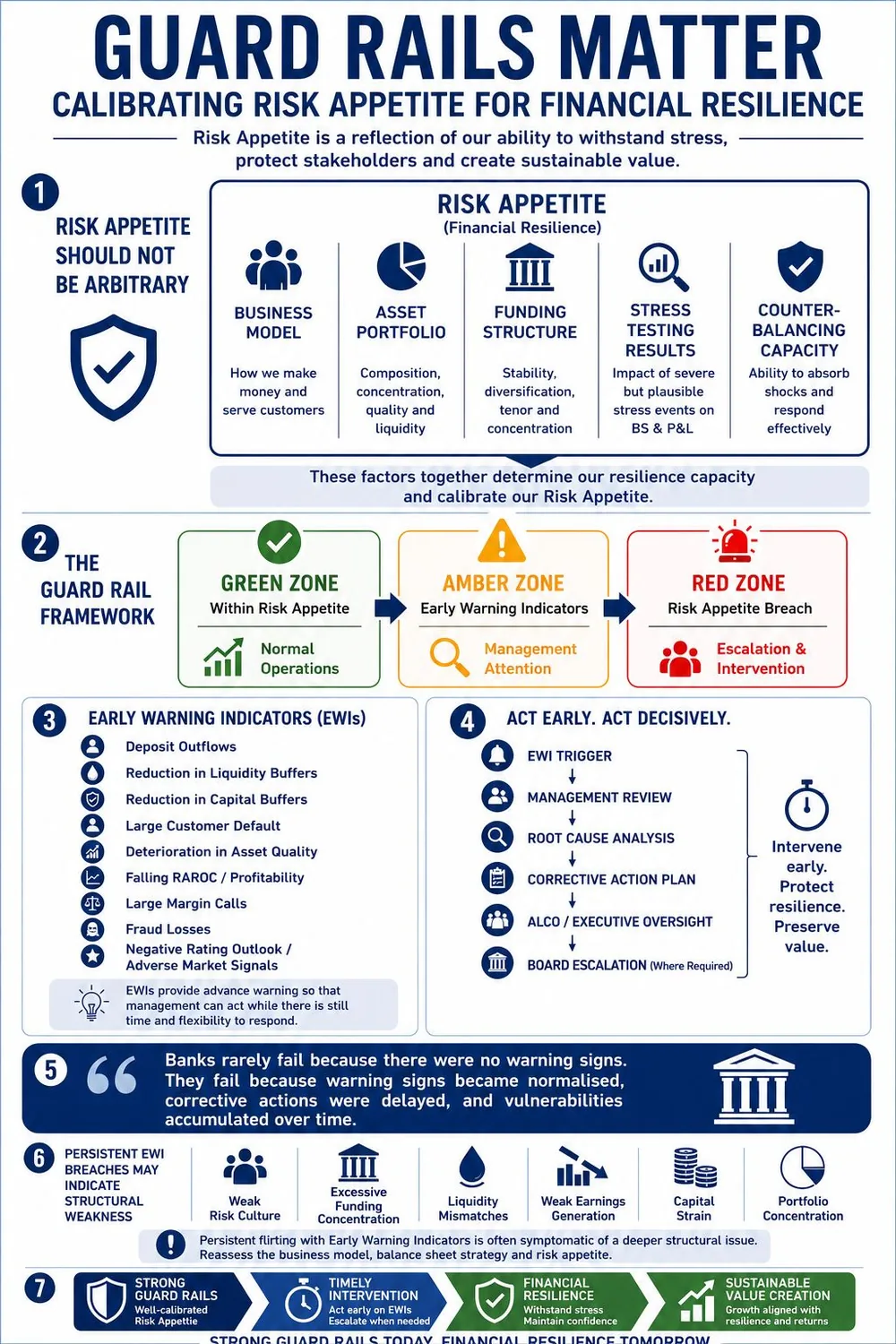
Risk Appetite is a reflection of our ability to withstand stress, protect stakeholders and create sustainable value.
Following recent bank failures, much attention has focused on capital adequacy, liquidity buffers, funding stability and risk governance. While these are all critical components of financial resilience, many institutions overlook a fundamental question: how does one determine whether the institution is taking the right amount of risk? This is where setting an appropriate Risk Appetite (RA) becomes important.
Too often, Risk Appetite Frameworks are treated as a collection of limits and thresholds set above regulatory minima, reviewed periodically but seldom linked to the institution's business model, strategy or resilience capacity.
In reality, RA should act as the institution's guardrails — defining the boundaries within which management can pursue growth and profitability while preserving its ability to withstand stress and maintain stakeholder confidence.
RA should not be determined by judgment alone. Nor should it be based solely on peer comparisons or regulatory expectations. Every institution has a different business model, portfolio composition, funding profile and resilience capacity. Consequently, RA must be calibrated to reflect the institution's specific vulnerabilities and ability to absorb shocks.
Key considerations include:
Together, these factors determine the institution's resilience capacity and calibrate its Risk Appetite.
However, establishing RA is only part of the solution. Institutions also require robust Early Warning Indicators (EWIs) that provide advance notice of emerging vulnerabilities before risk appetite limits are breached.
Examples include rising funding costs, widening bond spreads, deteriorating asset quality, significant margin calls, negative rating outlooks, and declining capital or liquidity buffers (refer to the EBA for a full list).
Most importantly, EWIs should not be merely reported. They should trigger a structured escalation process — EWI trigger, management review, root cause analysis, corrective action plan, ALCO / executive oversight and, where required, board escalation.
Persistent breaches of EWIs are often symptomatic of deeper structural weaknesses — a weak risk culture, excessive funding concentration, liquidity mismatches, weak earnings generation, capital strain or portfolio concentration. Persistent flirting with Early Warning Indicators should prompt a reassessment of the business model, balance sheet strategy and risk appetite itself.
Strong institutions treat EWIs as an opportunity to act pre-emptively — before vulnerabilities evolve into a full-blown crisis. When RA is calibrated through Integrated Stress Testing (IST) and supported by EWIs, it becomes one of the most powerful tools available to Boards and Executive Management.
Strong guard rails today, financial resilience tomorrow.
Join the discussion on LinkedIn
Part of The Balance Sheet Doctor — Sterling Consulting's Building Financial Resilience series.
This insight examines how a calibrated risk appetite links governance, capital, liquidity and portfolio quality through Early Warning Indicators.
Explore the full interdependency map →Whether you are building a Risk Appetite Framework from scratch or testing whether your current one is fit for purpose, a structured review can align it with your business model, stress testing and Early Warning Indicators.
Request a Diagnostic Review