Nvidia's proposed $250bn backstop is being read as the moment AI financing turned circular. It isn't. Oracle got there first — and it did it with cash.
By Sridhar Aiyangar, Founder & Managing Director · August 2026
On 26 July 2026, the Wall Street Journal reported that Nvidia is in talks to guarantee roughly $250 billion of financing behind a 10-gigawatt data centre campus in Piketon, southern Ohio. Bloomberg, Reuters and CNBC have since confirmed the outline of the discussions. Terms are not final, and the arrangement could still change or collapse.
The structure, as reported: SB Energy, SoftBank's power subsidiary, is developing the campus on a decommissioned uranium-enrichment site about 70 miles south of Columbus. OpenAI would lease it. Nvidia would stand behind the lease commitments and construction financing. The first phase, around 800 megawatts, is targeted for 2028. Total project cost including silicon is estimated at ~$500 billion, which would make it the largest data centre development ever announced.
Two details in the reporting deserve more attention than they are getting. The first is what the $250 billion does not cover: the guarantee applies to the lease and the construction debt — it excludes the chips. Financing for those is a separate negotiation, reported at up to $350 billion more. The second is that Nvidia is acting as a backstop, and not giving cash.
A backstop is a guarantee — a financial commitment to cover the obligations if the project or its tenant falls short. No cash moves on day one. What is being extended isn't capital; it's Nvidia's creditworthiness, rated AA by S&P — a currency Nvidia can lend without any cash outlay until there is a default.
OpenAI does not hold an investment-grade credit rating. It remains unprofitable; loss estimates for 2026 sit near $14 billion on revenue of roughly $25 billion. Long-term construction and lease financing at $500 billion scale is effectively unavailable to a borrower in that position through conventional channels. Nvidia's balance sheet is among the strongest anywhere, and with its AA rating it guarantees OpenAI's lease commitments. A guarantee lets lenders underwrite the debt against Nvidia's credit rather than OpenAI's, and lets SB Energy raise it on materially better terms.
Bankers have a name for this. It is called credit substitution, and it is a common structure: a parent guarantees its subsidiary's obligations, and the bank issues the letter of credit on the strength of that guarantee rather than the subsidiary's own standing. The borrower's economics do not improve. Only the perceived risk of the paper does — the risk is transferred to the parent and crystallises upon default.
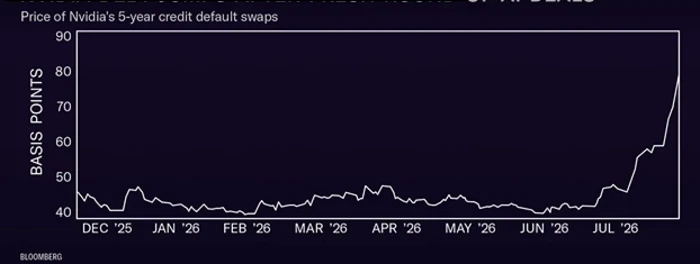
Contingent rather than funded, but credit markets treat it as an exposure. It is off the balance sheet until it isn't. The credit market registered the point before the story broke. Nvidia's five-year CDS traded in a narrow 40–45bp band from December through June — the market agreeing with S&P's AA (upgraded by one notch on 11 June 2026), six weeks before the Journal published. The spread began widening in early July, was through 60bp before the story ran, and spiked to roughly 82bp in the days after: a doubling, on a credit whose fundamentals had not changed and whose rating had just been raised. The contract has only traded actively since late 2025, so some of that is thinness. But the direction is unambiguous — the traded price of Nvidia risk moved while the rating did not.
The lenders are taking Nvidia risk. Nvidia is taking OpenAI risk. And Nvidia's own revenue depends heavily on continued spending by a small number of AI labs. That makes it circular.
The guarantor's ability to honour the guarantee is tied to the same demand the guarantee was written to create. In credit, that is the structure you worry about — not size, but everything deteriorating together.
A supplier extends capital or credit support. The recipient funds infrastructure. The infrastructure runs on the supplier's hardware. The supplier books revenue. This completes the loop.
Supplier extends credit → Recipient funds infrastructure → Infrastructure runs on the supplier's hardware → Supplier books revenue → back to the supplier
Critics call it round-tripping. Defenders call it vendor financing. Both can be true. The question that actually matters is simpler: how much of this demand exists without the financing?
It is worth being precise about who is in which circle, because it is widely muddled. The Ohio campus is being developed by SoftBank's energy arm, not Oracle. Oracle's exposure is a separate matter — a five-year contract reported at more than $300 billion to supply OpenAI with cloud capacity under Stargate. There isn't one circle here. That's a web.
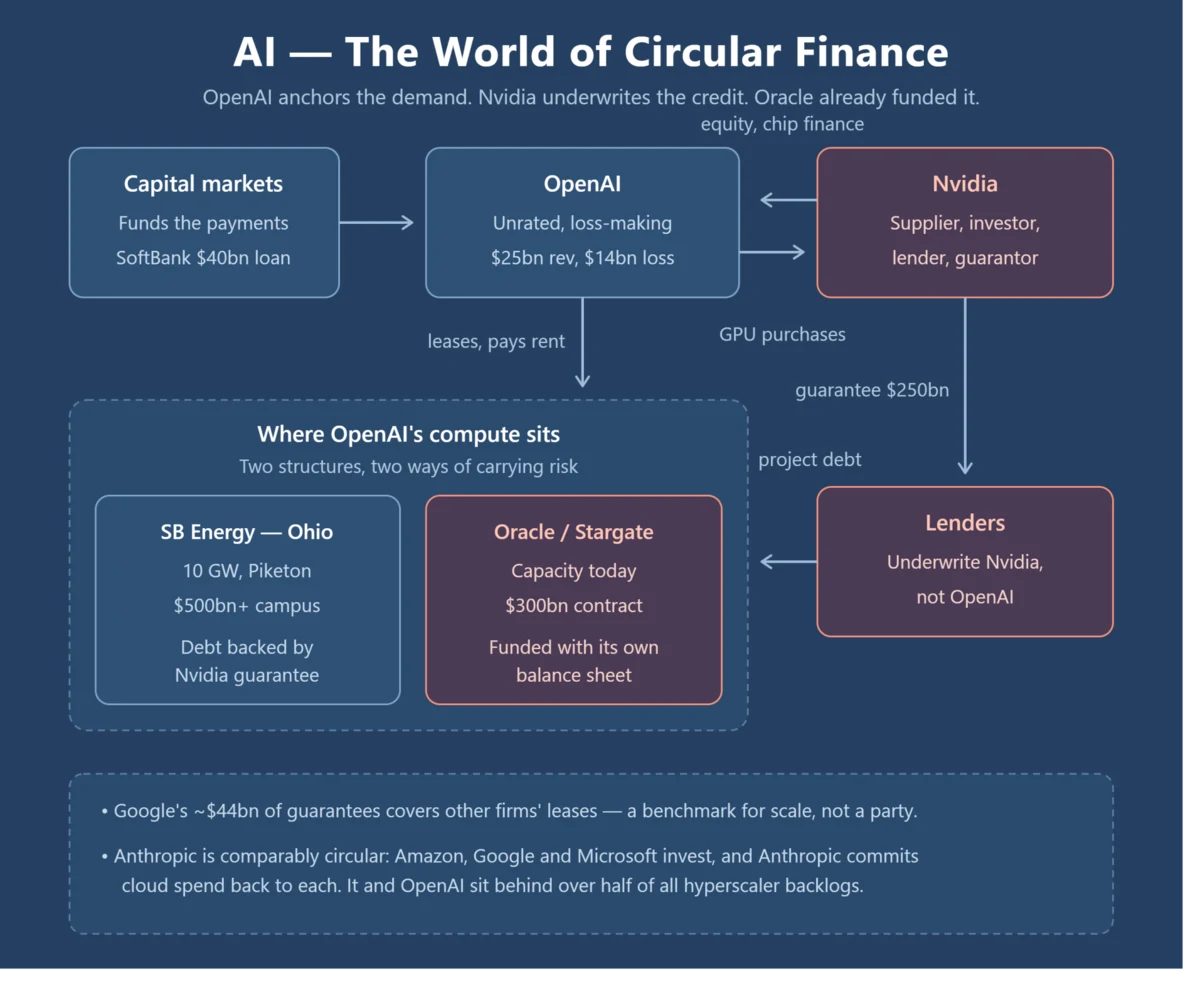
The Nvidia guarantee is generating the headlines. Oracle's position is the one already carrying the risk, and structurally it is the more exposed of the two.
Start with the form of the exposure. Nvidia's guarantee is contingent: it bites only on default, costs nothing if the tenant pays, and amortises as lease payments are made. Oracle's exposure is funded. To serve the contract, Oracle borrowed, bought hardware and poured concrete ahead of a dollar of revenue. Debt has climbed above $100 billion. Free cash flow has gone negative in fiscal 2026. Moody's has warned that debt is growing faster than earnings, with leverage heading toward four times EBITDA.
Then the client concentration. The OpenAI contract represents close to half of Oracle's remaining performance obligations — a backlog that has swelled past $600 billion. Nearly half of a company's contracted future revenue sits with a single unrated, unprofitable counterparty, one whose stated path to servicing those obligations runs through a public listing that has not happened yet.
Then the asset. A purpose-built campus with one anchor tenant is difficult to redeploy. GPUs at least have a secondary market while demand holds; a shell in Abilene does not. Specialised assets against concentrated counterparties is the combination that turns a credit problem into a workout — and we haven't even considered the enormous environmental footprint of this project, and the potential risk of water scarcity and GHG emissions.
Stargate is effectively a leveraged infrastructure project whose annual debt service could approach Oracle's entire current operating cash flow. The investment thesis therefore depends on long-term contracted demand, high data-centre utilisation, continued access to capital markets, and disciplined execution.
The credit market moved before the equity market did. Lenders reportedly began declining to participate in new Stargate-related financings where Oracle was the anchor tenant, and at least one data centre developer pivoted to a different hyperscaler after its lenders flagged Oracle counterparty concentration. Meanwhile Oracle's shares have fallen roughly by half from their September peak, while the analyst consensus stayed overwhelmingly positive — 41 of 51 covering analysts still rating it a buy through the decline.
Two markets looked at the same company and reached different conclusions. Equity prices a distribution with unbounded upside, where a low-probability severe scenario barely registers. Credit prices that scenario directly, because it is the whole of the exposure.
One point in Oracle's favour, in fairness: it is being paid for the risk it took. There is a contract with revenue attached. In Nvidia's case, the guarantor is writing a $250 billion credit guarantee for no fee and no equity upside — taking exposure for nothing except the demand it creates for its own product. Which is precisely the correlation problem, restated.
Set the two side by side and a sequence appears:
Equity → Prepayment → Guarantee → Funded balance-sheet debt
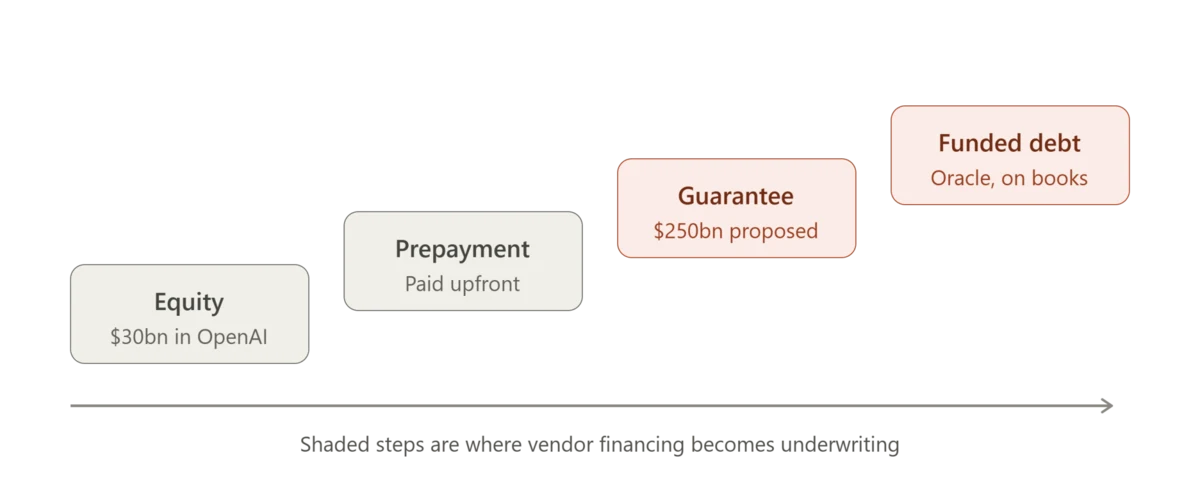
Each step moves further out the risk curve. Equity is capped at what you put in. A prepayment is money out, but against delivery. A guarantee is unbounded but contingent. Funded debt is unbounded and already spent. Nvidia has taken the first step ($30 billion of equity in OpenAI's last round) and is now discussing the third. Google has guaranteed roughly $44 billion of other companies' data centre rent — the proposed Nvidia backstop would be nearly six times that. Oracle is standing on the fourth.
None of this is unique to OpenAI. Anthropic's suppliers are also its investors: Amazon has put in up to $33bn while Anthropic commits more than $100bn to AWS; Microsoft invested up to $5bn against a $30bn Azure commitment; Google's investment sits alongside a reported $200bn cloud agreement. Dollars leave as investment and return as revenue, exactly as they do in the Nvidia loop. And the concentration runs deeper than any single vendor's disclosure suggests: contracts with these two labs reportedly account for more than half of the roughly $2 trillion of backlog at AWS, Azure and Google Cloud, with Anthropic alone said to represent over 40% of Google's.
Oracle's position isn't an anomaly. It is the industry's structure — visible earlier because Oracle had less balance sheet to hide it behind. Oracle borrowed the money and spent it. The difference worth tracking is not whether a supplier is circular, but how far out the risk curve it has stepped: Anthropic's backers took equity, the first rung; Nvidia is discussing a guarantee. Same ladder, different rung.
In the telecom build-out, equipment vendors financed the carriers buying their equipment. Growth looked spectacular until customer economics weakened and capital markets closed. Vendor-financed revenue turned out to be the least durable revenue on the books.
But let's be fair about where the analogy fails. Dot-com vendors financed customers with no revenue and no product. AI has both. OpenAI's revenue has gone from roughly $12bn annualised in mid-2025 to about $25bn in early 2026. The compute shortage is real. Nvidia's cash generation is real. The concern isn't that the technology is fake.
It's that announced commitments are being capitalised into valuations as if every dollar converts into sustainable demand — where some of those purchase commitments exist because the supplier made them financeable.
And in fairness to the other side: vendor financing is legitimate and ancient. Every transaction in the chain delivers a real product at a negotiated price. A capital-rich party underwriting capacity that everyone needs, in the right conditions, is efficient. Nvidia's guarantee may well be the cheapest way to get 10 gigawatts built. That argument is sound. It was also sound in 1999 — until the cost of capital changed.
The AI opportunity is real. The compute demand is real. The progress isn't in question. None of that is what's being tested. In every technology boom, the question was never whether the technology works — it's whether the economics still work when capital gets expensive and growth slows. That's the test now in front of this ecosystem. The guarantees being written today will determine the answer, but the funded positions taken 18 months ago will be the first to report it.
Figures as of early August 2026. The Nvidia backstop remains under negotiation and unconfirmed by either company. Nothing stated here is investment advice.
Join the discussion on LinkedIn
Part of The Balance Sheet Doctor — Sterling Consulting's Building Financial Resilience series.
Correlation, concentration and the difference between contingent and funded risk are exactly what a balance-sheet lens is built to surface. Talk to us about reading exposure the way credit markets do.
Request a Diagnostic Review