Capital is not simply a regulatory constraint. Properly managed, it is a strategic resource — absorbing risk, enabling growth, retaining strategic optionality and determining the sustainable returns a bank can generate from its balance sheet.
By Sridhar Aiyangar, Founder & Managing Director · September 2026
For many banks, capital management remains too closely associated with the annual ICAAP exercise and demonstrating compliance with regulatory minima. That understates both its purpose and its strategic importance. Effective capital management should answer a much broader set of questions:
Answering these questions requires the integration of three foundations — the Baseline Plan, the ICAAP Framework and an Integrated Stress Testing Framework — which together transform capital management from a point-in-time regulatory assessment into a continuous, forward-looking discipline and an integral component of financial resilience. The timing matters: in the UK the Financial Policy Committee's system-wide capital benchmark sits at around 11% CET1 and 13% Tier 1 of RWA, the Bank of England's stress test has become a back-stop rather than a binding constraint, and Basel 3.1 and the PRA's Pillar 2A reforms take effect together on 1 January 2027. Headline requirements are stable or falling, but the burden of demonstrating adequacy is shifting to the bank's own plan, ICAAP and stress testing.
Every strategic decision has a capital consequence. Growth consumes capital; changes in portfolio composition alter RWA; concentrations create risks that Pillar 1 may not capture; earnings replenish capital while distributions remove it; acquisitions, disposals, securitisations and risk transfer reshape both the amount and the efficiency of capital employed. Capital management therefore sits at the intersection of:
Strategy → Balance Sheet → Risk → Earnings → Capital → Returns
The objective is not to maximise capital ratios: excess capital has an economic cost just as insufficient capital creates vulnerability. It is to maintain sufficient capital and counterbalancing capacity to absorb plausible stresses while deploying capital efficiently to generate sustainable risk-adjusted returns. That requires understanding not only today's position but the trajectory of capital under baseline and stressed conditions — and the capacity available to respond when vulnerabilities emerge.
The baseline establishes the expected evolution of the balance sheet, profitability, RWA and capital resources under business-as-usual assumptions: growth, portfolio composition, margins, costs, credit losses, dividends, capital issuance and strategic initiatives — and, increasingly, the regulatory trajectory itself, including the transition to final Basel standards and the recalibration of Pillar 2 that accompanies it. A credible plan projects earnings and retained capital, balance-sheet and RWA growth, CET1, Tier 1, total capital and leverage, regulatory and management buffers, distribution capacity, capital consumption by business and headroom against Risk Appetite. A baseline that is optimistic on margins or inconsistent with the funding plan undermines everything built on top of it.
But the baseline answers only one question: what happens if our assumptions broadly materialise? Capital management must also understand what happens when they do not.
Pillar 1 requirements capture important risks but are not intended to represent the complete economic risk profile of every institution. Banks must, therefore, identify the material risks arising from their own business model, portfolio structure and concentrations, and assess whether additional capital is required. This is where Pillar 2A risks matter: credit concentration — sectoral, geographic and single-name; interest rate risk in the banking book; pension risk; operational and conduct risk beyond the Pillar 1 charge; model, business, liquidity and strategic risk; credit exposures that standardised approaches understate; and other institution-specific vulnerabilities. A bank can report a comfortable Pillar 1 ratio while carrying substantial risk outside the assumptions of standard regulatory calculations.
Two points are easy to miss. Supervisors increasingly rely on the bank's own Pillar 2A assessment rather than published benchmarks — the PRA is retiring its refined methodology and IRB benchmarking from 2027 — so the quality of the ICAAP analysis, not the regulator's formula, determines the outcome. And Pillar 2A risks rarely scale with RWA: a pension deficit or a single-name concentration is what it is regardless of the size of the loan book, so allocation that ignores these drivers under-estimates concentrated businesses. ICAAP therefore asks a fundamentally different question:
If the baseline establishes where the bank expects to go and the ICAAP identifies the risks it carries, stress testing determines how resilient that trajectory is when the environment moves materially against it. It should not be an annual calculation performed after the plan is complete; it should actively challenge the plan's assumptions and test the portfolio of material risks. An integrated framework examines the transmission of severe but plausible shocks through the bank's financial architecture:
Macroeconomic Shock → Customer Behaviour → Credit Deterioration → Market Movements → Income Compression → Funding & Liquidity Effects → RWA Migration → Losses → Capital Depletion
A recession does not simply raise credit losses. It may simultaneously reduce loan growth, compress income, increase Stage 2 and 3 exposures, inflate RWA through rating migration, raise funding costs, deplete capital through valuation decline on investment portfolios (OCI impact) and constrain organic capital generation — and under Basel 3.1 the binding constraint may switch between modelled, floored and leverage measures as the scenario unfolds. The combined impact can far exceed the sum of risks considered independently. That is why integrated stress testing — one engine serving the ICAAP, the liquidity assessment, the recovery plan and the regulator — is essential.
The purpose of stress testing extends well beyond confirming that the bank stays above its minimum CET1 ratio. It tests the bank's portfolio of risks under severe but plausible conditions to assess its risk capacity, informed by the counterbalancing capacity provided by credible management actions. This creates an important distinction:
Risk Capacity is the level of risk the institution can withstand while continuing to meet its critical commitments and operating requirements. Risk Appetite is the level and types of risk the Board is prepared to accept in pursuit of its strategic objectives.
Risk Appetite must operate within Risk Capacity, with enough headroom to respond to adverse developments before fundamental constraints become binding. Understanding Risk Capacity therefore requires more than the gross impact of a stress; it requires understanding the bank's ability to respond.
A bank may have significant financial and management capacity to absorb or mitigate a gross stress impact — existing capital headroom, earnings generation, RWA and balance-sheet flexibility, capital actions, and risk mitigation and transfer. The management question becomes: how much stress can the bank absorb, what can management do as vulnerabilities emerge, how quickly can those actions be executed, and what vulnerability remains? This creates the core resilience sequence:
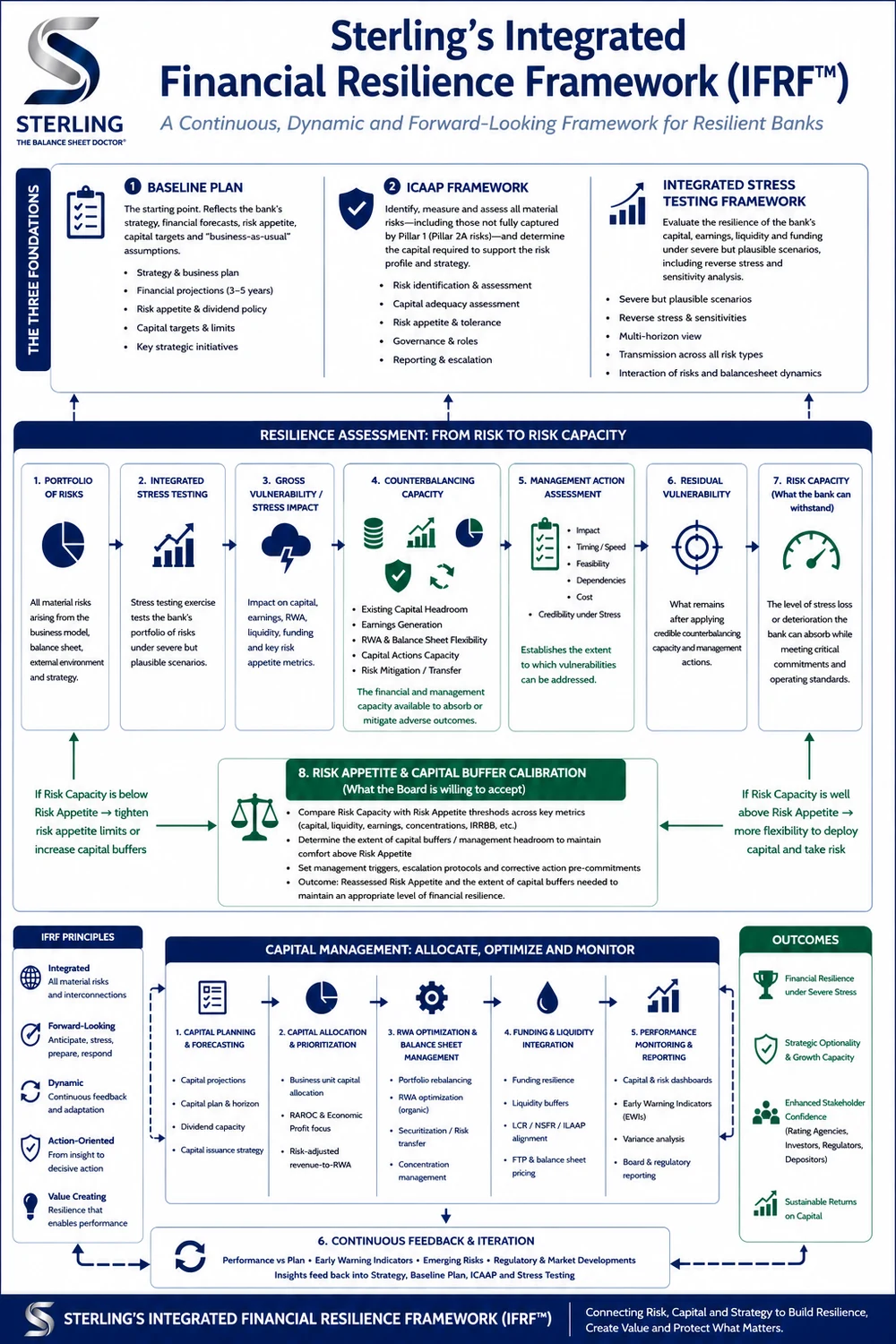
Portfolio of Risks → Integrated Stress Testing → Gross Vulnerability → Counterbalancing Capacity → Management Actions → Residual Vulnerability → Risk Capacity
Two banks with an identical gross stress impact may have very different risk capacities if one has substantially greater ability to generate earnings, release capital, reshape its balance sheet or transfer risk.
Management actions should not be assumptions inserted at the end of a stress test; they are a core component of the institution's capacity to respond before vulnerabilities threaten its resilience. They span capital actions (retaining earnings, restricting dividends, issuing instruments, disposals), RWA optimisation (rebalancing, collateral, securitisation, risk transfer), balance-sheet actions (constraining growth, managing concentrations), earnings actions (repricing, cost reduction) and risk actions (tighter underwriting, limits, hedging). But they have value only to the extent that they are credible and executable in the circumstances in which they would be required: capital markets close when most needed, portfolio sales take quarters, and a dividend cut may trigger market perception and stakeholder concerns. Each action should be evaluated across:
Impact × Timing × Feasibility × Dependencies × Cost × Credibility under Stress
A useful discipline is to present actions on a ladder — business-as-usual, contingency (haircut and time-lagged) and recovery (counted only with great caution) — and to show results at each rung. The gap between pre- and post-action outcomes is the most informative number in the exercise: it tells the Board how much resilience is intrinsic and how much rests on management doing difficult things under pressure. The residual vulnerability after credible counterbalancing capacity is a far better measure of Risk Capacity than the gross impact alone.
This leads to one of the most important principles of an integrated framework. Assessing Risk Capacity, informed by the counterbalancing capacity of management actions, leads directly to reassessing Risk Appetite and the extent of capital buffers needed:
Risk Capacity → Risk Appetite & Capital Buffer Calibration
Where Risk Capacity is only marginally above Risk Appetite, the bank has limited room to absorb unexpected deterioration and tighter limits, greater headroom or higher buffers may be appropriate. Where it comfortably exceeds Risk Appetite and management has credible, rapidly executable counterbalancing capacity, there is more flexibility to deploy capital and take risk. In practice the calibration is expressed in the capital stack: regulatory buffers above the Pillar 1 and Pillar 2A requirement, a supervisory buffer sized from stress results, and above those the management buffer that expresses the Board's own appetite, with triggers and pre-committed actions linked to recovery-plan indicators.
Once the resilience requirement is established, capital management becomes an allocation discipline. Every business competes for a finite resource, and the question is not whether an exposure generates accounting profit but whether it earns an adequate return on the capital and risk it consumes. RAROC, economic profit and risk-adjusted revenue-to-RWA distinguish businesses that consume capital and create value from those that do not, portfolios capable of structural optimisation, and opportunities to redeploy released capital at superior returns, provided the capital charged reflects Pillar 2A drivers and stress-loss consumption, not only Pillar 1 risk weights.
Optimisation is not indiscriminate RWA reduction. Cutting RWA while destroying valuable franchises, or maximising RAROC by simply shrinking the balance sheet, undermines future earnings capacity. The objective is to increase the productivity of capital while preserving the resilience and strategic capacity of the institution.
Capital management cannot operate as a standalone discipline. Capital resilience depends on the interaction between strategy, balance sheet, earnings capacity, risk profile, liquidity and funding, stress vulnerabilities and management's ability to respond. A capital action that repairs CET1 but impacts franchise is a good capital answer but a bad balance-sheet answer. This is the principle underpinning Sterling's Integrated Financial Resilience Framework (IFRF™). Three foundations establish the starting point — the baseline plan, ICAAP and integrated stress testing; these feed the resilience assessment, and Risk Capacity informs the calibration of Risk Appetite, buffers, headroom, triggers and limits. Capital management then determines how the available capacity is deployed:
Capital Planning → Capital Allocation → RWA Optimisation → Balance-Sheet Management → Performance Monitoring
And the framework does not end there. Performance against plan, emerging risks, early-warning indicators, regulatory change and actual experience feed continuously back into strategy, the baseline plan, the ICAAP and stress testing. The IFRF is continuous rather than periodic, dynamic rather than static, and action-oriented rather than purely diagnostic.
A well-capitalised bank can absorb shocks. A financially resilient bank can do more: absorb shocks, respond effectively and retain strategic optionality — continuing to lend when competitors retreat, acquiring assets in dislocation, protecting ratings and funding access, and investing in strategically important businesses. That optionality has considerable value, and it is what distinguishes financial resilience from regulatory compliance.
A resilient institution does not merely know how much capital it holds. It understands what risks it carries; how they behave under stress; how much vulnerability that creates; what counterbalancing capacity management possesses; which actions remain credible under adverse conditions; how much residual vulnerability remains; what level of risk it can withstand; and how much of that Risk Capacity the Board is prepared to utilise. Capital adequacy answers only part of the question.
Integrated financial resilience determines whether the institution can withstand adversity, respond before vulnerabilities become constraints, preserve strategic capacity and continue to create sustainable value. That is the purpose of strategic capital management — and why it sits at the heart of Sterling's Integrated Financial Resilience Framework (IFRF™).
Join the discussion on LinkedIn
Notes: IFRF™ is a proprietary methodology of Sterling Consulting. UK regulatory references are as understood at September 2026: FPC capital benchmark (Financial Stability Report, December 2025); 2025 Bank Capital Stress Test results (December 2025); Basel 3.1 and PRA Pillar 2A Phase 1 reforms effective 1 January 2027; PRA PS2/26. This article expresses the author's views and is not regulatory advice.
Part of The Balance Sheet Doctor — Sterling Consulting's Building Financial Resilience series.
This insight examines how capital connects strategy, portfolio, IRRBB, liquidity and earnings — and how integrated stress testing turns those interactions into risk capacity, risk appetite and efficient capital deployment.
Explore the full interdependency map →If you want an independent view of how your baseline, ICAAP and stress testing translate into genuine risk capacity — and how efficiently your capital is deployed — a structured diagnostic can surface it before it matters.
Request a Diagnostic Review